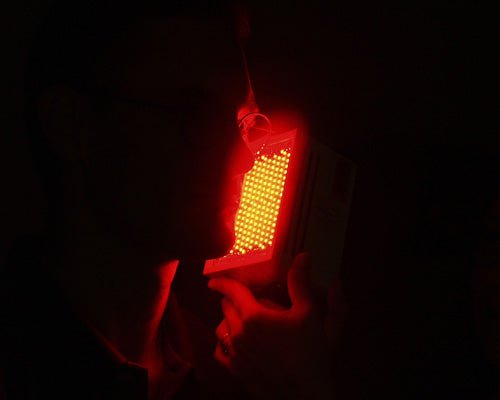

NASA ASTROCULTURE™ red LED arrays originally engineered for growing crops in microgravity. Public domain image courtesy of NASA.
The Space-Age Origin of Red Light Therapy
Red light therapy is widely used in modern wellness clinics, athletic training facilities, and home care routines. However, its medical validation began high above Earth in NASA space missions. If you are exploring high-performance recovery solutions, Elite Wellness HQ offers premium tools inspired by this groundbreaking technology.
NASA photobiomodulation research transformed high-tech LED arrays engineered for space greenhouses into a therapeutic tool for biological recovery, wound healing, and cellular rejuvenation.
The NASA Discovery: How Space Farming Led to Biological Healing
During the 1990s, NASA’s Space Product Development Program funded plant growth experiments inside the Space Shuttle’s ASTROCULTURE™ chamber. To grow crops in microgravity without heavy, hot light bulbs, NASA partnered with Quantum Devices, Inc. to engineer specialized red and near-infrared light-emitting diode (LED) arrays.
- NASA ASTROCULTURE Spaceflight Experiments (1995): Development of solid-state spaceflight arrays.
- Photosynthetic Validation: Red (670 nm) LED plant growth chambers successfully produce crops in microgravity.
- Spaceflight Observation: Astronaut slow wound healing observed under microgravity conditions.
- Medical College of Wisconsin Trials: Clinical research led by Dr. Harry Whelan evaluates mammalian cellular response.
- Empirical Proof: 140% to 200% acceleration in human and animal cell growth proven in controlled studies.
Researchers noticed a secondary benefit: the high-intensity 670 nm red light that drove photosynthesis also accelerated cell division and tissue repair. NASA contracted Dr. Harry T. Whelan at the Medical College of Wisconsin to investigate whether LED light could reverse the slowed wound healing experienced by astronauts in microgravity.
The results established that targeted red (670 nm) and near-infrared (830 nm) LED light accelerated human cell growth by 140% to 200% in laboratory models, opening new possibilities for non-invasive medical phototherapy. Today, you can access these exact wavelengths using an advanced red light therapy panel at Elite Wellness HQ.

Dr. Harry T. Whelan demonstrating the NASA-developed LED probe. Public domain image courtesy of NASA Marshall Space Flight Center.
How Photobiomodulation Works: Boosting Mitochondrial ATP
Red light therapy relies on mitochondrial energy production. Mitochondria serve as the powerplants inside human cells, generating adenosine triphosphate (ATP) to drive cellular function and tissue repair.
- Step 1: Target tissue absorbs visible red (670 nm) or near-infrared (830 nm) light photons.
- Step 2: Photons are absorbed by Cytochrome C Oxidase in the mitochondrial electron transport chain.
- Step 3: Photonic stimulation breaks the competitive bond holding inhibitory Nitric Oxide (NO) to the enzyme.
- Step 4: Free oxygen binds to the enzyme, boosting cellular energy (ATP) production and microvascular circulation.
When tissues suffer from trauma, stress, inflammation, or poor blood circulation, nitric oxide (NO) binds to Cytochrome C Oxidase—a critical enzyme in the mitochondrial energy chain. Nitric oxide acts like a governor on an engine, blocking oxygen absorption and slowing ATP production.
Targeted light therapy supplies the precise photonic energy needed to clear this bottleneck:
- Photon Absorption: Cytochrome C Oxidase absorbs red (630–670 nm) and near-infrared (810–880 nm) light photons.
- Nitric Oxide Dissociation: Light breaks the bond holding nitric oxide to the enzyme, freeing it to bind oxygen again.
- ATP Energy Boost: Mitochondrial respiration speeds up, driving higher ATP production to fuel cell regeneration and reduce recovery times.
- Enhanced Circulation: Released nitric oxide dilates local blood vessels, increasing oxygen delivery and nutrient distribution to recovering tissue.
| Spectral Wavelength | Depth Penetration | Target Tissue / Primary Biological Benefit |
|---|---|---|
| Visible Red Light (630–670 nm) |
1–2 mm (Epidermal & Dermal Layers) |
Collagen production, fine line reduction, surface wound healing, skin tone optimization |
| Near-Infrared Light (810–880 nm) |
20–50 mm (Subcutaneous & Deep Tissue) |
Joint pain relief, skeletal muscle recovery, deep inflammation management, bone health |
Key Benefits Proven by NASA Research and Clinical Trials
NASA-sponsored clinical trials and subsequent peer-reviewed studies demonstrated significant physiological benefits across multiple applications:
- Accelerated Wound Healing: NASA LED therapy decreased animal wound sizes by 36% and promoted tissue growth across epithelial cells, fibroblasts, and bone-building osteoblasts.
- Muscle Recovery and Pain Relief: In clinical trials with Naval Special Warfare personnel (Navy SEALs), LED therapy reduced recovery time for acute training injuries by over 40%.
- Chemotherapy Side-Effect Management: Clinical trials at bone marrow transplant centers showed that 670 nm LED light reduced painful chemotherapy-induced oral mucositis in pediatric cancer patients by 47%.
- Enhanced Cellular Collagen Synthesis: Photobiomodulation upregulates structural genes responsible for producing integrins, collagen, and laminin, supporting skin structure and joint resilience.
Selecting an LED Red Light Therapy Device
When evaluating an LED red light therapy device, mechanical design and optical engineering dictate performance. Focus on these core technical parameters:
- Targeted Wavelengths: Ensure the device outputs validated wavelengths, specifically 660–670 nm red light for skin health and 830–850 nm near-infrared light for deep tissue recovery.
- Sufficient Irradiance: Irradiance measures optical power delivered per unit surface area (mW/cm²). Look for targeted red light therapy panels providing 50–100 mW/cm² at a comfortable distance (6–12 inches) to deliver therapeutic doses within 10–15 minute sessions.
- Solid-State LED Matrix Design: Choose planar LED matrices that provide uniform light distribution across broad target areas rather than spot-focused devices.
By selecting devices engineered according to NASA’s light therapy research from Elite Wellness HQ, users can access space-tested photobiomodulation technology directly in their home or clinic.
Conclusions
NASA’s photobiomodulation research illustrates how solving an operational spaceflight challenge, growing crops and maintaining astronaut health in microgravity can drive major advancements in terrestrial medicine. By establishing that non-coherent semiconductor light-emitting diodes (LEDs) match the biostimulatory effects of lasers without their accompanying cost, thermal output, or safety hazards, NASA provided the foundation for modern clinical and consumer light therapy.
Biophysically, the dissociation of nitric oxide from Cytochrome C Oxidase by red (670 nm) and near-infrared (830 nm) light restores mitochondrial respiration, increases cellular ATP synthesis, and triggers gene expression pathways responsible for soft-tissue and musculoskeletal repair. For engineers, clinicians, and consumers alike, NASA’s work demonstrates that photobiomodulation is a predictable, dose-dependent photochemical process that uses light energy to optimize biological performance.